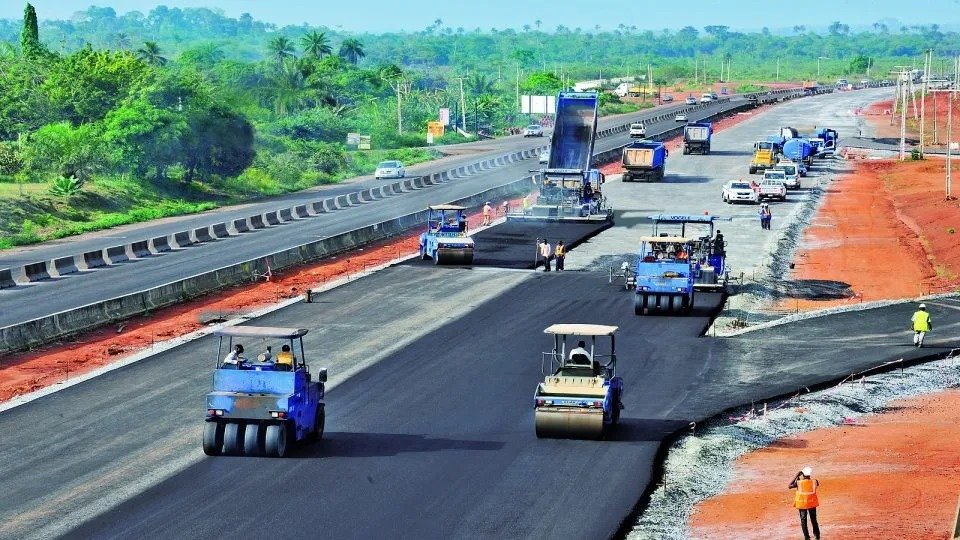
There is a particular kind of frustration that every Nigerian knows intimately. It is the frustration of watching potential sit idle, of knowing that something great is within reach but finding the road to it, literally and figuratively, broken.
It shows up in the manufacturer who cannot move goods because the highway is impassable. It shows up in the farmer who watches produce rot because there is no storage, no cold chain, no reliable road to market. It shows up in the small business owner running a generator at the cost of a small fortune, simply to keep the lights on through another stretch of grid failure.
This is not a story of insufficient ambition in Nigeria. It is a story of infrastructure, and what happens to an economy when the foundation beneath it is cracked.
Where Nigeria Stands Today
Nigeria is Africa's largest economy, and by many measures, it carries the weight of that status with remarkable resilience. The numbers, however, reveal a country being slowed at every turn by what is missing beneath its feet.
Economic Performance
- GDP expanded by 3.9 percent in the first half of 2025, up from 3.5 percent in the same period of 2024
- The Central Bank of Nigeria projects GDP growth at 4.17 percent for 2025
- The World Bank projects 3.6 percent for the same year
- GDP growth in 2024 accelerated to its fastest pace since 2015, driven primarily by services and a modest recovery in oil output
The Infrastructure Gap
- Nigeria's infrastructure stock constitutes only 30 percent of GDP, far below the World Bank's recommended benchmark of 70 percent
- The country faces an infrastructure financing gap estimated at 100 billion dollars
- Infrastructure decay alone costs the economy an estimated 2 percent of GDP annually
These are not insignificant numbers. But they exist alongside a reality that no projection of economic acceleration can ignore.
The Real Cost of Infrastructure Failure
Power Supply Collapse
Electricity is not merely a convenience. It is the foundation on which manufacturing, technology, healthcare, education and commerce all depend.
- Annual economic losses from unreliable electricity are estimated between 5 and 7 percent of GDP, amounting to roughly 25 billion dollars every year
- Average daily power supply is estimated at roughly four hours for those connected to the grid
- Some regions go days without supply at all
- 43 percent of the Nigerian population, approximately 85 million people, still lack access to grid electricity
- Nigeria holds the record as the country with the world's largest energy access deficit
- 96 percent of industrial energy consumption in Nigeria is produced off-grid at enormous private cost
- An estimated 14 to 20 gigawatts of power is supplied off-grid through private generators
Roads and Transportation Breakdown
- Only about 30 percent of Nigeria's estimated 200,000 road networks are paved
- Rail transport contributed less than 1 percent of the transportation sector's share to GDP in 2023
- Poor road networks cost farmers and traders billions annually in post-harvest losses and delayed deliveries
These figures, taken together, do not describe a nation climbing steadily upward. They describe one being held back at every junction.
What Infrastructure Investment Actually Does
What infrastructure investment does to an economy is more than the construction of physical things. It rewires opportunity.
A well-maintained road that connects a rural farming community to an urban market does not just move goods, it multiplies income. It lowers transport costs, reduces post-harvest losses, encourages commercial farming at scale, and brings buyers and sellers into the same conversation.
Key multiplier effects include:
- The International Labour Organization notes that every dollar invested in infrastructure generates roughly three to four times more jobs than the same amount invested in other sectors
- Agriculture, which employs a significant share of Nigeria's workforce and contributes approximately 22.7 percent of GDP, would be among the biggest beneficiaries
- A reliable national power grid would change the arithmetic of doing business in Nigeria entirely, making local production more competitive and attracting foreign investment
- Small and medium enterprises freed from generator dependency could redirect capital into growth, hiring and product development
Government Steps and Current Investment Direction
There is growing evidence that Nigeria's current administration understands the urgency. The pace of progress remains uneven, but the direction has become clearer.
Budget and Policy Commitments
- The 2025 Federal Budget allocated 4.06 trillion naira, approximately 2.7 billion dollars, for infrastructure, representing 7.4 percent of total spending
- The National Integrated Infrastructure Master Plan targets increasing infrastructure stock to 70 percent of GDP by 2043
- A 2.7 billion dollar Infrastructure Corporation of Nigeria Limited fund, backed by the Central Bank of Nigeria, Africa Finance Corporation and the Nigerian Sovereign Investment Authority, has been established to channel investment into bankable projects
External Investment Confidence
- The African Development Bank's 2025 Country Strategy Paper commits 2.95 billion dollars over four years, with an additional 3.21 billion dollars in co-financing toward Nigeria's development
- The government has moved toward public-private partnerships as a primary mechanism for closing the financing gap that public spending alone cannot bridge
These are meaningful steps. What must follow them is something Nigeria's development history has struggled to guarantee consistently, which is delivery.
Transportation: The Circulatory System of the Economy
Transportation infrastructure is not one sector among many. It is the circulatory system of every functioning economy, and Nigeria's most direct path to unlocking interior markets.
Rail Connectivity
The revival of railway connectivity, illustrated by the Abuja-Kaduna standard gauge rail line, demonstrated what is possible when rail infrastructure is genuinely operationalized.
Expanded and well-managed rail networks achieve several things at once:
- They reduce the pressure on roads that were never designed for freight volumes they now carry
- They lower the cost of moving goods across long distances
- They open up interior regions for commercial activity that currently cannot access markets competitively
- They reduce the security risks associated with long-distance road haulage
Port Modernization
The Lekki Deep Sea Port, commissioned in 2022 at a cost of 1.5 billion dollars, with a water depth of 16.5 meters capable of accommodating large vessels previously unable to dock in West African waters, signals what Nigeria's logistics infrastructure can look like when vision and execution align. Several states are already developing similar frameworks, which means replicable templates now exist.
Digital Infrastructure: The New Economic Highway
Digital infrastructure belongs at the center of any serious conversation about Nigerian economic growth. Nigeria's technology sector has earned its description as one of Africa's most dynamic, attracting significant investment and generating employment for a young, increasingly skilled population.
Broadband penetration, however, remains uneven, with large portions of the country underserved by reliable internet connectivity.
Digital infrastructure is a prerequisite for:
- Fintech expansion and financial inclusion for the unbanked
- Remote business operations and distributed employment
- E-commerce connecting producers directly to consumers across state lines
- Agricultural market access platforms that give farmers real-time pricing data
- A knowledge economy that converts a youthful population into a genuine demographic dividend
The African Development Bank's Investment in Digital and Creative Enterprises programme, launched with 618 million dollars in funding and targeting Nigeria's creative economy, is projected to create six million jobs and generate 6.4 billion dollars for the economy. That figure alone makes the case for digital infrastructure investment more powerfully than any policy document.
The Obstacles Between Nigeria and Infrastructure-Led Growth
What stands between Nigeria and infrastructure-led growth is not a shortage of ambition, nor a shortage of resources in absolute terms. It is a convergence of structural failures that have historically undermined project delivery.
Persistent Governance Challenges
- Corruption in procurement drives up project costs and reduces value delivered
- Abandoned projects across successive administrations leave communities with half-built infrastructure that serves no one
- Security challenges in regions like the Northwest and Northeast raise construction costs and deter long-term investors
- An insufficient commitment to maintenance once projects are completed means that completed infrastructure deteriorates faster than new investment can replace it
These obstacles strip the value from investment before it ever reaches the people it was meant to serve. Addressing them is not a separate conversation from infrastructure development. It is the same conversation.
What the World Has Already Proven
The examples from elsewhere are instructive without being prescriptive.
South Korea's sustained infrastructure investment over decades enabled it to become a global technology and manufacturing power from a position that, in the 1960s, was not much stronger than Nigeria's today. Singapore built one of the world's most competitive economies, in large part, on the strength of its logistics and connectivity infrastructure. Rwanda, a far smaller economy, transformed its investment climate through targeted infrastructure improvements paired with governance reforms, and became a continental model for how institutional quality and physical development reinforce each other.
None of these countries shared Nigeria's resource endowment or market size. What they shared was a consistent, long-term commitment to treating infrastructure not as a political reward to be distributed among constituencies, but as an economic investment with returns that compound across generations.
The Path Forward
The World Bank's Nigeria Development Update for 2025 projects growth rising from 4.2 percent this year to 4.4 percent by 2027. Getting beyond that range, into the territory of transformative per-capita growth that actually reduces poverty and expands opportunity for ordinary Nigerians, will require infrastructure investment at a scale and quality that the country has not yet consistently achieved.
Services-led growth without a supporting infrastructure base has a ceiling. Manufacturing, agriculture, logistics, energy and technology cannot reach their potential in an environment where power is unreliable, roads are degraded, ports are congested and digital connectivity is patchy.
Nigeria does not need to be told it has potential. Every Nigerian already carries that knowledge. What the country needs now is the infrastructure that converts potential into output, that moves grain from farms to cities without spoilage, that keeps factories running through the night without the roar of generators, that connects a student in Kebbi State to a digital classroom with the same reliability as one in Victoria Island.
That is not idealism. That is a policy choice. And it is one that carries the weight of 220 million lives.
CMA News covers economic growth, investment trends and development policy across Nigeria and Africa. This article was produced by the CMA News Senior Editorial Desk.
Comments (0)