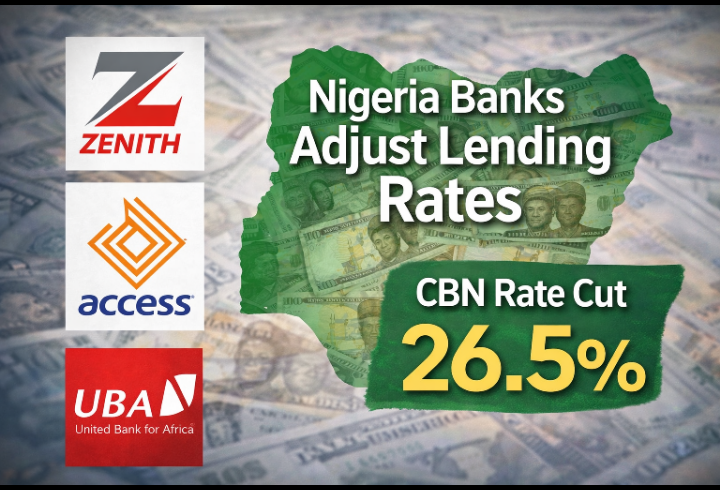
The Central Bank of Nigeria (CBN) has announced new lending rates across Nigerian banks after reducing the Monetary Policy Rate (MPR) from 27% to 26.50%.
The decision was announced during the 304th Monetary Policy Committee (MPC) meeting held in Abuja. According to CBN Governor Olayemi Cardoso, members of the committee unanimously agreed to cut the rate by 50 basis points.
“The committee decided to reduce the monetary policy rate by 50 basis points to 26.50 percent,” Cardoso said.
Banks adjust lending rates
Following the policy change, Nigerian banks have released updated lending rates for businesses and individual customers.
Data published by the CBN shows that the average prime lending rate is now about 24%, while the average maximum lending rate stands at 32%.
Prime lending rates are usually offered to customers with strong credit profiles and lower risk, while maximum lending rates apply to customers considered higher risk.
Among the major banks:
- Zenith Bank set its prime lending rate at 25% and maximum lending rate at 32%.
- Access Bank announced a 25.50% prime rate and 32% maximum rate.
- United Bank for Africa (UBA) fixed its prime lending rate at 28.50% with a 32% maximum rate.
Other banks such as First Bank, Fidelity Bank, Sterling Bank, Wema Bank, and Polaris Bank also released updated lending rates reflecting the new policy direction.
What the rate cut means for the economy
The reduction in the MPR is aimed at easing borrowing costs and supporting economic activity in Nigeria.
Lower interest rates can encourage businesses to access loans for expansion, investment, and job creation. Small and medium-sized enterprises (SMEs), which depend heavily on bank loans, could benefit if borrowing becomes more affordable.
For consumers, lower lending rates may also make it easier to access credit for housing, education, and other personal needs.
Economic analysts say the move could stimulate business growth and increase financial activity across different sectors of the economy if banks pass the lower rates on to borrowers.
Lending activity in Nigerian banks
Recent financial data shows that lending by Nigerian commercial banks continues to grow. Loans to customers from ten major banks reached ₦66.49 trillion in the first nine months of 2024.
The banks recorded an average Loan-to-Deposit Ratio (LDR) of 46.72%, meaning that for every ₦100 deposited by customers, about ₦46 was given out as loans.
The CBN says publishing lending rate data is part of its transparency policy aimed at helping businesses and individuals make better financial decisions.
If lending conditions improve further, the policy could support investment, strengthen businesses, and contribute to economic growth across Nigeria.

Comments (0)