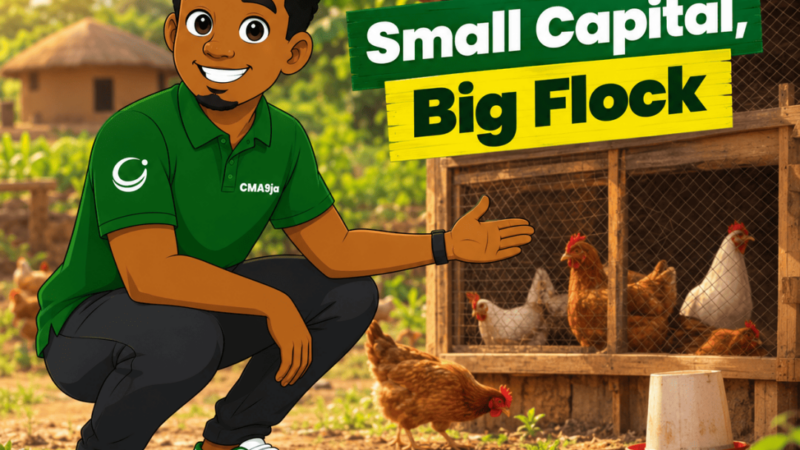
Nigeria farms over 200 million birds a year, and demand still outstrips supply. That gap is exactly why poultry remains one of the most accessible agribusiness opportunities for someone starting with modest capital; a backyard setup with 50 to 100 birds can realistically begin for as little as ₦150,000 to ₦350,000.
Here’s how to start small, manage your costs properly, and grow from there.
Ad
Broilers or Layers: Choose Based on Your Cash Flow Needs
Broilers, raised purely for meat, reach market weight in just 6 to 8 weeks, giving you rapid returns and the ability to run five to six production cycles a year. A fully grown broiler sells for ₦2,000 to ₦4,500 depending on size and weight, and 1,000 broilers can realistically net ₦2,000,000 to ₦2,500,000 per cycle once you account for feed and other costs.
Layers take longer to mature, 18 to 22 weeks, before they start producing, but then provide steady daily income through egg sales for up to 72 weeks. A healthy flock of 200 layers can produce around 190 eggs daily, roughly 6 crates, and with eggs selling at approximately ₦2,300 per crate, that’s meaningful steady cash flow once your birds reach peak production.
Ad
If you need income sooner and want faster capital turnover, start with broilers. If you want steadier, longer-term cash flow and can wait out the maturity period, layers are the stronger choice.
Realistic Starting Capital for a Small Setup
For a genuinely small farm of 100 to 200 birds, budget ₦150,000 to ₦350,000 total. This typically breaks down as a simple wooden mesh pen or basic poultry house (₦50,000-₦150,000 using affordable, locally available materials), day-old chicks (₦250-₦500 each depending on breed), your first 5 to 7 bags of feed at ₦10,000-₦12,000 per bag, and ₦20,000-₦30,000 for vaccines, tools, and miscellaneous costs.
Ad
Feed is your highest recurring cost by far, accounting for roughly 70% of total running expenses, so budgeting accurately here matters more than any other line item. Start with fewer birds than you think you can manage, prove the model works, and expand gradually as profits allow rather than overextending on day one.
Setting Up Without Overspending
You do not need to own land to start. A backyard setup works genuinely well for a first attempt, provided it’s dry, clean, away from flood-prone areas, and has reliable access to water. Allow roughly 1.5 square feet of space per bird, use affordable materials like timber, wire mesh, and corrugated iron sheeting rather than expensive concrete construction, and ensure proper ventilation from day one, since poor airflow is one of the fastest ways to lose birds to respiratory disease.
Ad
The free-range or semi-intensive system requires less upfront capital than a fully enclosed deep-litter house, though it carries a higher risk of losing birds to predators or theft. Weigh this tradeoff honestly based on your specific location and security situation before deciding.
Health, Feed, and Avoiding Common Losses
Vaccination is non-negotiable. A standard vaccination and medication programme for a small flock typically costs ₦15,000 to ₦35,000 per cycle and covers Newcastle Disease, Infectious Bursal Disease (Gumboro), and basic vitamin and electrolyte supplements during brooding. Skipping this to save money is the single most common way new farmers lose their entire flock to a preventable outbreak.
Ad
Feed conversion efficiency directly determines your profit margin. Nigerian farms typically operate at a feed conversion ratio of 2.0 to 2.3, meaning it takes roughly 2 to 2.3 kilograms of feed to produce 1 kilogram of meat, compared to more efficient international benchmarks. Reducing feed wastage, maintaining clean water access, and preventing disease outbreaks can meaningfully improve your bottom line, often by 20% or more.
Finding Buyers Before You Need Them
Line up your market before your birds mature, not after. Build relationships with local butchers, market wholesalers, and restaurants for broilers, and with retail outlets or a direct customer base for eggs. Waiting until harvest time to find buyers risks selling at a discount out of urgency rather than at a fair, planned price.
Ad
Here Is What to Do Right Now
Choose broilers or layers based on whether you need faster returns or steadier long-term income.
Start with 50 to 200 birds and a realistic ₦150,000 to ₦350,000 budget, rather than overextending on your first attempt.
Build your housing with affordable, locally available materials, prioritizing ventilation and predator security over expensive finishes.
Budget properly for vaccination, ₦15,000-₦35,000 per cycle, and never skip this to cut costs.
Secure at least one or two buyers before your birds are ready for market or laying age.
Poultry farming rewards patience with disease prevention and consistency with feeding far more than it rewards a big starting budget. Start small, manage your costs and health protocols carefully, and reinvest your first cycle’s profit into scaling up.












Be the first to comment
Leave a Comment
Only registered members can leave comments. Log In
No comments yet
Be the first to share your thoughts!
Reply to Comment