
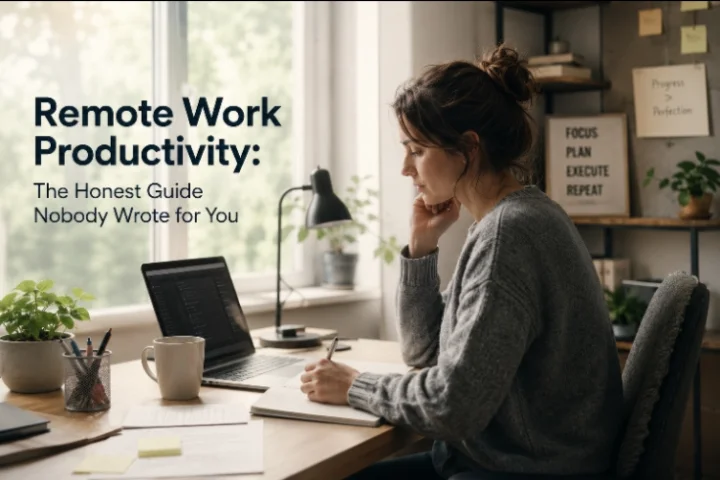
This guide is about building the former, deliberately, with the right tools, the right habits, and a realistic view of how remote teams actually function.
Your Environment Is Doing More Than You Think
Most people treat their workspace as an afterthought. A corner of the bedroom. A kitchen table with a laptop propped up on a stack of books. It works well enough, they figure, so why invest more thought into it.
The problem is that your brain takes constant cues from its physical surroundings. When you sit at a kitchen table where you also eat breakfast and scroll your phone at night, your nervous system doesn’t automatically switch into work mode. It’s confused. And a confused brain defaults to low-effort tasks, checking email, reorganizing files, doing anything that feels productive without requiring deep concentration.
 General
CMA9ja Expands Job Search Opportunities for Nigerians with Employer Job Posting and Free CV Builder
General
CMA9ja Expands Job Search Opportunities for Nigerians with Employer Job Posting and Free CV Builder
The fix doesn’t require a dedicated home office with expensive furniture. It requires consistency and intention. Pick a spot and use it only for work. Even if it’s a corner of a shared room, the ritual of sitting there signals to your brain that it’s time to focus. Close the door if you have one. Put on headphones even if you’re not playing anything. Change out of whatever you slept in. These small physical cues are surprisingly powerful because they mimic the transition that a commute used to provide.
If background noise helps you concentrate, there’s real science behind why. Tools like Brain.fm, which uses AI-generated music designed specifically for focus states, or even a simple brown noise track on YouTube, give your brain just enough stimulation to stay alert without pulling your attention away. Some people swear by coffee shop ambiance. Others need silence. The point is to figure out what works for you and replicate it consistently, not whatever productivity influencers say works for them.
The Tools That Actually Move the Needle
The remote work software market is enormous and mostly overwhelming. Every team seems to be running a different stack, and the advice you find online usually reads like a sponsored product roundup. So here’s a more honest cut of what genuinely matters.
Communication needs a single front door. The biggest productivity killer in remote teams isn’t distraction, it’s fragmentation. Conversations split across Slack, email, WhatsApp, and impromptu Zoom calls mean that critical information lives in five different places and nobody can find anything. Pick one primary channel for team communication and protect it. Most teams use Slack or Microsoft Teams, and both work fine as long as the team actually commits to using them consistently rather than leaking out to other channels constantly.
 General
The Human Cost of Meta’s AI Bet: What 8,000 Vanished Jobs Tell Us About Where Tech Is Heading
General
The Human Cost of Meta’s AI Bet: What 8,000 Vanished Jobs Tell Us About Where Tech Is Heading
Async-first thinking changes everything. One of the biggest mental shifts remote work requires is learning that not everything needs an immediate response. Tools like Loom, which lets you record short video messages instead of scheduling a meeting, and Notion or Confluence for shared documentation, enable what is called async communication. You do your part, leave clear context, and the next person picks it up when they’re ready. Teams that master this don’t just save time on meetings. They think more carefully before communicating because they know their message has to stand on its own without them there to clarify it in real time.
Project visibility beats micromanagement every time. When a manager can’t see their team working, the temptation is to over-check: status update emails, unnecessary Slack pings, daily standups that turn into monitoring sessions. Tools like Linear, Asana, or Trello solve this not by surveillance but by shared visibility. When everyone can see what’s in progress, what’s blocked, and what’s done, the need for constant check-ins drops significantly. Managers get peace of mind. Employees get autonomy. Both sides win.
Time tracking for yourself, not your boss. There’s a version of time tracking that’s about surveillance, and it’s corrosive to trust. Then there’s a version you do voluntarily for yourself, and it’s genuinely eye-opening. Apps like Toggl or Clockify let you see exactly where your hours go. Most people who try this for one week are surprised. The three-hour deep work block they thought they were doing turns out to be 90 minutes of actual work bookended by Slack and context switching. Knowing that is the first step to changing it.
The Habits That Separate the Disciplined from the Drifting
Tools don’t build discipline. Habits do. And in a remote environment, the habits that keep you focused and sane are different from what most productivity content tells you.
 General
Delivery Driver Job in Shrewsbury, Shropshire | £25,392.28 per Year
General
Delivery Driver Job in Shrewsbury, Shropshire | £25,392.28 per Year
Start your day with a single non-negotiable. Before you open email, before you check Slack, identify the one thing that actually needs to happen today. Not a list of ten things. One. The thing that, if you did nothing else, would make the day a success. Write it down. Work on it first, before the reactive noise of the day pulls you in other directions. This habit alone, practiced consistently, has a bigger impact than almost any tool or technique you could layer on top of it.
Protect deep work like it’s a meeting. In an office, nobody thinks twice about blocking two hours for a meeting. But two hours of uninterrupted focus time? Somehow that always gets fragmented. Block it on your calendar. Set your status to Do Not Disturb. Close every tab that isn’t directly related to what you’re working on. Deep work, the kind where you’re fully concentrated on a complex problem without interruption, is what produces the best results. It’s also the first thing to go in a reactive remote environment if you don’t actively protect it.
Build real stopping points into your day. Remote work famously blurs the line between work time and personal time. Without a commute to physically separate them, many people find themselves checking Slack at 9 p.m. or starting their laptop “just for a second” on Sunday afternoon. This isn’t dedication. It’s a slow erosion of the psychological distance you need to actually rest and come back sharp the next day. Create a shutdown ritual. At a set time, close your laptop, write down where you left off and what’s first tomorrow, and mentally close the work chapter of the day. It sounds simple and it is, but most remote workers don’t do it, and they pay for it in cumulative exhaustion.
Take breaks on purpose, not by accident. Accidental breaks, scrolling your phone because you’re stuck, wandering to the kitchen because you’re bored, aren’t restoring your focus. Intentional breaks are. The research behind techniques like Pomodoro (25 minutes of work, 5 minute break) isn’t really about the specific timing, it’s about the principle that your brain needs periodic recovery to sustain performance. Step away from your screen. Walk around. Look at something further than six feet away. A 10-minute break taken deliberately is worth more than 30 minutes of half-distracted pseudo-work.
 General
EFCC Operations Threaten Nigeria Tech Industry and Youth Employment
General
EFCC Operations Threaten Nigeria Tech Industry and Youth Employment
Managing Remote Teams Without Making Everyone Miserable
If you’re a manager or team lead, remote work puts a specific kind of pressure on you. The old playbook, visibility equals accountability, doesn’t translate. You can’t manage by walking the floor. What you can do is manage by outcomes, and build the kind of communication culture that makes your team feel connected rather than monitored.
The single biggest mistake remote managers make is defaulting to more meetings when they feel out of touch. It feels like the obvious solution. If I can’t see what’s happening, I’ll create forums where I can check in. The problem is that meetings are extraordinarily expensive in a remote context, because they interrupt the focused work time that remote environments are actually good at enabling. Before scheduling any recurring meeting, ask honestly whether a well-written async update would serve the same purpose. Usually it would.
The second mistake is measuring activity instead of output. It doesn’t matter how many hours someone is logged into Slack. It matters what they shipped, what they decided, what they moved forward. Remote work forces managers to get clear on what they actually need from each role, which is uncomfortable but ultimately makes the whole team more effective.
What works instead is a combination of clear expectations, documented decisions, and regular one-on-ones that are genuinely about the person, not just the work. When an employee knows exactly what success looks like in their role, has access to the context they need to make decisions, and feels like their manager sees them as a human being rather than a productivity unit, they don’t need to be monitored. They manage themselves.
The Mental Health Part Nobody Wants to Talk About
Remote work can be genuinely isolating. Not for everyone, and not all the time, but the absence of casual human contact that offices provide, the hallway conversations, the shared lunch, the spontaneous collaboration, adds up over time in ways people don’t always notice until they’re already feeling the effects.
Loneliness in remote workers is a real and documented phenomenon. It tends to affect people differently depending on their living situation and personality, but even self-described introverts can find that months of working alone quietly depletes something they can’t immediately name.
The practical responses aren’t complicated, but they do require intentionality. Schedule social time the same way you schedule work. Co-working spaces, even used once or twice a week, dramatically change the psychological texture of a remote workweek for many people. Virtual coffee chats with colleagues, when they’re genuinely social rather than work-adjacent, help maintain the human connections that distributed teams need to function well over long periods.
Taking your lunch break away from your screen and treating it as actual rest, not just a meal eaten while reading Slack, is a small thing that compounds meaningfully over time.
The Honest Bottom Line
Remote work isn’t a productivity hack. It’s an entirely different relationship with your time, your environment, and the people you work with. Done well, it gives you back hours of your life, removes the friction of unnecessary meetings and open-plan office interruptions, and lets you do your best work on your own terms. Done poorly, it quietly drains you while making you feel like you’re always working without ever fully feeling like you’re getting anything done.
The difference between those two outcomes isn’t luck or personality type. It’s the decisions you make about your tools, your habits, and the kind of work culture you either build or tolerate.
Start with your environment. Protect your deep work. Build a real end to your day. And if you manage a remote team, lead with trust first, because the people who feel trusted tend to be the ones who earn it.
Discussion 0